Last week I had the opportunity to take a break from work and help out with my home church's Vacation Bible School, a week-long day camp for kids. I was in charge of a romping crew of 5 first-graders and my job was to make sure I didn't step on or lose any throughout the day (neither the VBS director nor the nervous parent of a shy child appreciated my comment, "I'm usually really good about keeping the kids very focused. Last year, I only lost three of them") and to help them pay attention to the different crafts and stories. It is a wonderful ministry and I have found that I learn as much from it as the kids do. Here is my reflection on this year's VBS.
The Mystery of Faith
Perhaps the greatest thing I have learned this week at VBS lies in a greater revelation of the integrity of the Christian gospel. The truths that were taught to me when I was growing up are the same as those I tried to teach to my kids, the only difference being that I used my personal experiences to frame my narratives.
There is no greater or more objective principle than this: God loves you and He sent his son Jesus to die on the cross for your sins, and Jesus came back to life so that He could reconnect you to God upon acceptance of His sacrifice. I cannot add or take away clarity or veracity to so simple and elegant a message. The mystery of faith lies in the duplicity of the complexity of this paradox: "Why" this happens is apparent to all of us (even my first graders know: "Because God loves us"), but "Why me" begets the question no theologian, philosopher, mathematician, economist, or mystic can answer: "How much?" At the core of the human element lies our innate imperfection and sinfulness, and a simple glimpse or mere exposure to this core evokes feelings of disgust, horror, and dread. It is not difficult to understand "why" God chose to redeem humanity -- for even we know that human love will cause others to do things which we might regard as sacrificial, strange, noble, or foolish -- but as we begin to understand the depths of our failures we must also begin to question the extent of the love that can redeem us.
I love reading a good book but I would not sacrifice my life, much less a toe on my left foot, for the chance to read a good book, much less for someone else to have the chance to read a good book. How much grater that a Father should send His Son to die in order to reconcile the sins of humanity! Why am I worth it? Why does God love me so much? How much love does God have for me and when does it run out? The pillars of this week's VBS, no matter how for cornily presented, tackle these questions and doubts head-on. How do I tell the children that God's love or prayer or the Bible helps us stand strong? Is it with a hand motion or a song? What keyword or mnemonic device do I use to help them understand the theology behind the Crucifixion? How can you get the kids to understand the absolute and objective truth behind the Christian Gospel when you can't get them to understand that they should not try to cut each others' hair during craft time?
There is no greater frustration than to know the Truth and be unable to communicate it because of language, cultural, age, or other barriers -- to have Reality itself presented in front of you but be unable to share it with others. How can I get these kids to understand the truth presented to them when they are still at an age where their first guess at my age is 46? [Note: I am not and (I hope, anyway) don't look 46, either.]
Herein we return to the mystery of the common Christian faith: The Gospel transcends these barriers of age because it is true. Regardless of my struggles or interpretation of the Gospel, it is this objective truth behind this core element of faith that my crew is able to understand the teachings presented to them each day; not because we did an excellent job being leaders, but because there is no other alternative, because there is no other objective principle, because there is no other truth than that revealed by Christ's Crucifixion and Resurrection. That the kids can understand the greatest truth they will ever know -- that Jesus came to for them so they can be reunited in holy union with God -- in spite of the flaws and distractions of me, the leaders, VBS, and the church -- that is the mystery of faith.
Tuesday, August 20, 2013

Saturday, August 3, 2013
Oh, Yeah, July...
It seems July has passed me by entirely without having a single post...
Whoops.
Here's how I spent the month of July:
1) Reading: I finished, at the end of July, Ayn Rand's magnum opus Atlas Shrugged. I'm not sure if I will post a review of it or about it. It's simply one of those works that
2) Shopping: I discovered two new websites, one called eBay and the other PayPal. They make purchasing things online very easy, but you probably knew that, because, as my friend related to me, they "are already 'a thing.'"
3) Working: I have been very busy this summer -- not bad, since I've been rather productive. But having to come in on weekends and staying late has been a bit inconvenient. I would estimate I have been at work 9 or 10 hours a weekday and about 9 hours on a weekend for the most of July.
4) Traveling: I had the opportunity to go home and see my family for a week in July. That was a lot of fun, since I haven't seen any of them since Christmas.
Anyway, that was my July. With a bit of luck, I'll have more opportunities to post in August.
Have a great day!
Whoops.
Here's how I spent the month of July:
1) Reading: I finished, at the end of July, Ayn Rand's magnum opus Atlas Shrugged. I'm not sure if I will post a review of it or about it. It's simply one of those works that
2) Shopping: I discovered two new websites, one called eBay and the other PayPal. They make purchasing things online very easy, but you probably knew that, because, as my friend related to me, they "are already 'a thing.'"
3) Working: I have been very busy this summer -- not bad, since I've been rather productive. But having to come in on weekends and staying late has been a bit inconvenient. I would estimate I have been at work 9 or 10 hours a weekday and about 9 hours on a weekend for the most of July.
4) Traveling: I had the opportunity to go home and see my family for a week in July. That was a lot of fun, since I haven't seen any of them since Christmas.
Anyway, that was my July. With a bit of luck, I'll have more opportunities to post in August.
Have a great day!
Wednesday, June 26, 2013
Spain, Summer 2013
In late May-early June, some friends and I visited Spain for 2.5 weeks. We first visited a number of cities and then walked the last bit of the Camino de Santiago, the Way of St. James. The pilgrimage has many routes to Santiago; we started at the end of the French Way, which starts in southern France, takes pilgrims through northern Spain, enters Galicia (northwest Spain), and ends at Santiago de Compastela, the burial place of the Apostle James (the Lesser), a total distance of about 770km. We walked the last 130 or so kilometers.

MADRID  |
| A woman re-creating an original painting at the Prado A guard scolded me for taking this picture. |
 |
| The football stadium |
 |
| Plaza Mayor |
 |
| Cathedral de la Almudena |
 |
| Palacio Real de Madrid |
 |
| The bear and strawberry tree are the symbol of Madrid. This symbol was on the sidewalk. |
TOLEDO
"And if you look to your left, you will see Toledo, built by the Ohians as a stronghold against Michigan..."
 |
| The view of the city from one of the upper floors of the building's library Toledo is the notable because it has a synagogue, mosque, and a cathedral. The sword-making industry is also quite popular. |
 |
| A fresco from the walls at the Cathedral of Toledo |
 |
| Dome from Cathedral of Toledo |
 |
| Doorway, organ, and image of Christopher at the Cathedral of Toledo |
BURGOS
 |
| The Cathedral of Burgos |
 |
| The Cathedral of Burgos |
 |
| The dome of the Cathedral of Burgos The way the dome let in light was truly amazing. |
 |
| Light from stained glass windows on the floor. |
 |
| The window that caused the light to hit the floor in the picture above. |
 |
| We were walking through the city at night and passed by the Cathedral. They had lights projecting patterns onto the Cathedral. The effect was quite interesting; the textures of the light on the Cathedral were very vivid. |
LEON
 |
| View from my hotel overlooking Plaza Mayor |
 |
| Plaza Mayor, Saturday night The noise was horribly loud. Even at 2am I found it incredibly difficult to sleep. The next day, Sunday, the plaza was deathly empty for most of the day, a stark contrast to the noise, lights, and fellowship of the day before. |
 |
| The Cathedral at Leon |
 |
| This is called a Doner Kabob and it was delicious. It cost 4.50 euros. |
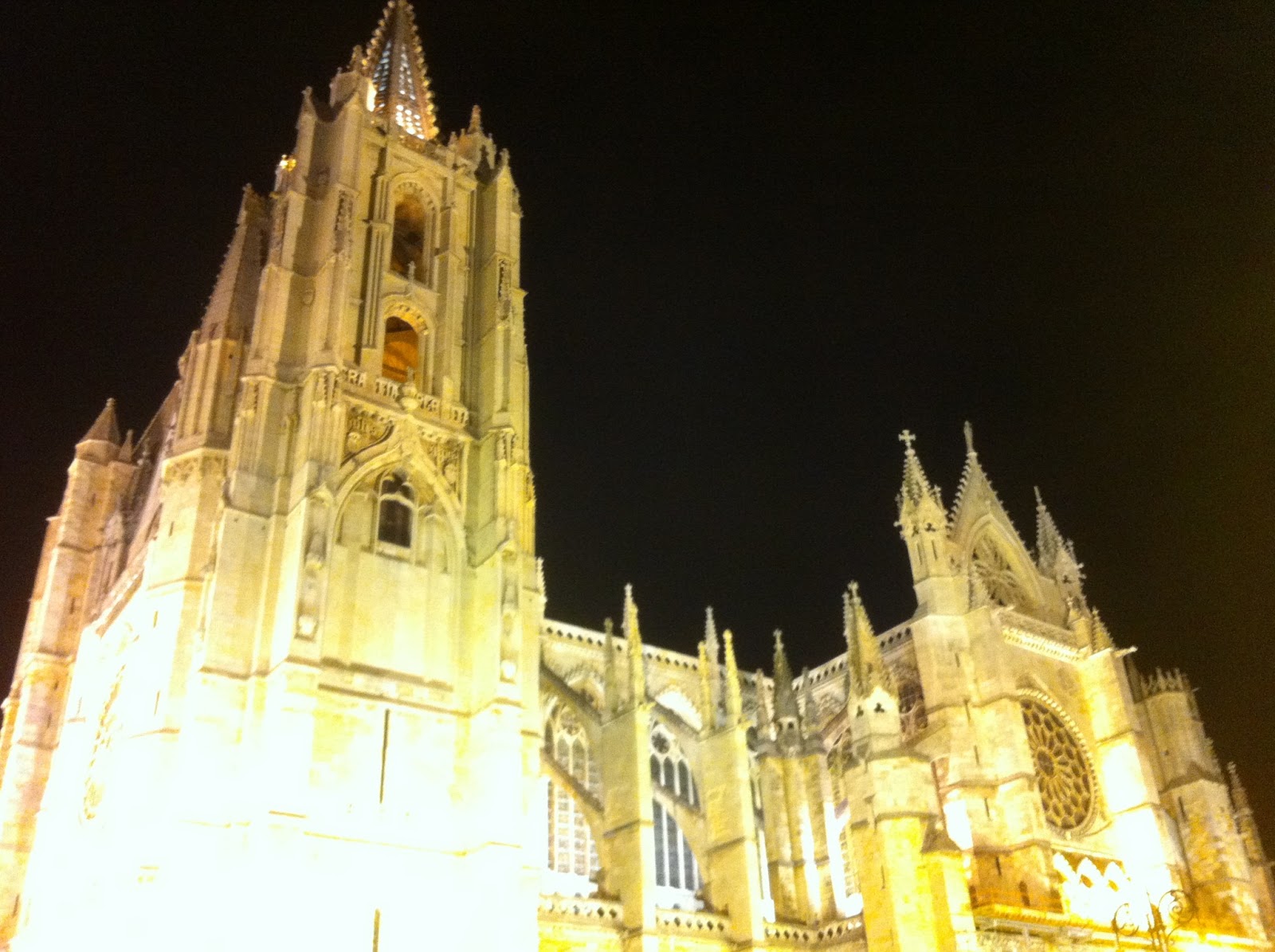 |
| The Cathedral of Leon |
LUGO
 |
| Lugo is surrounded by Roman walls. |

O CEBREIRO (START OF THE CAMINO DE SANTIAGO)
 |
| The church where we got out first sello, stamp on our passport. It was about 150 km from Santiago. |
 |
| The scallop shell is the symbol of St. James. Pilgrims (pereginos) wear the shells on their bags or persons to identify each other. This shell cost me 1.5 euros and is marked with the cross of St. James. |
 |
| All along the Camino are these yellow arrows to help you find where to go. They can be found on trees, rocks, road signs, on the ground, and even on buildings. |
 |
| These kilometer markers tell you how far you are from Santiago. |
 |
| A road marker Pilgrims carry rocks with them as a symbol of their sins along a stretch of the Camino and leave them on the kilometer markers or these road markers. |
 |
| Passsport with stamps The one in the upper left is from the monastery at Samos; the one from the upper right is from a hotel. Stamps can also be obtained also from churches, bars, cafes, and restaurants. |
 |
| A small community graveyard along the Camino. I noticed that the graves were all above ground and not in the ground. |
 |
| Along the Camino |
 |
| Along the Camino |
 |
| Along the Camino |
 |
| Along the Camino |
 |
| Along the Camino |
 |
| Along the Camino The Camino goes through many old towns. Most of these small towns are sparsely populated, with most of the buildings having fallen apart. Some of the buildings still operate as alburges, hostels for pilgrims, or as cafes for lunch. |
 |
| The interior of a monastery |
 |
| Along the Camino |
 |
| Along the Camino |
 |
| Along the Camino |
 |
| Along the Camino |
 |
| At one of the towns along the Camino, we stopped to eat octopus. It was rather oily and salty but very good. |
 |
| The Mount of Joy is the first place along the Camino where pilgrims can see the Cathedral de Santiago. This marker commemorates the time Pope John Paul II celebrated mass on the mountain. |
 |
| The Cathedral of Santiago de Compostela |
FINISTERRE
 |
| After reaching Santiago, pilgrims traditionally continued West until they reached Finisterre, what was believed to be the end of the world. This is the most Western point in Europe. |
SALAMANCA
 |
| The Cathedral at Salamanca |
Monday, June 10, 2013
Veterans
The other day someone told me that his friend, after obtaining her doctorate in psychology, will be going to work for a veteran's association.
I sat in the car as he continued, saying how she would be moving in the next couple weeks. I wasn't really paying attention, though, to what he was saying afterwards. You see, I was stuck wondering why veterans needed psychologists. Was working with animals really that stressful? Or perhaps the psychologists are for the pets. Do animals need therapy, too?
And then I realized my mistake.
I sat in the car as he continued, saying how she would be moving in the next couple weeks. I wasn't really paying attention, though, to what he was saying afterwards. You see, I was stuck wondering why veterans needed psychologists. Was working with animals really that stressful? Or perhaps the psychologists are for the pets. Do animals need therapy, too?
And then I realized my mistake.
Subscribe to:
Posts (Atom)
People Counter
